
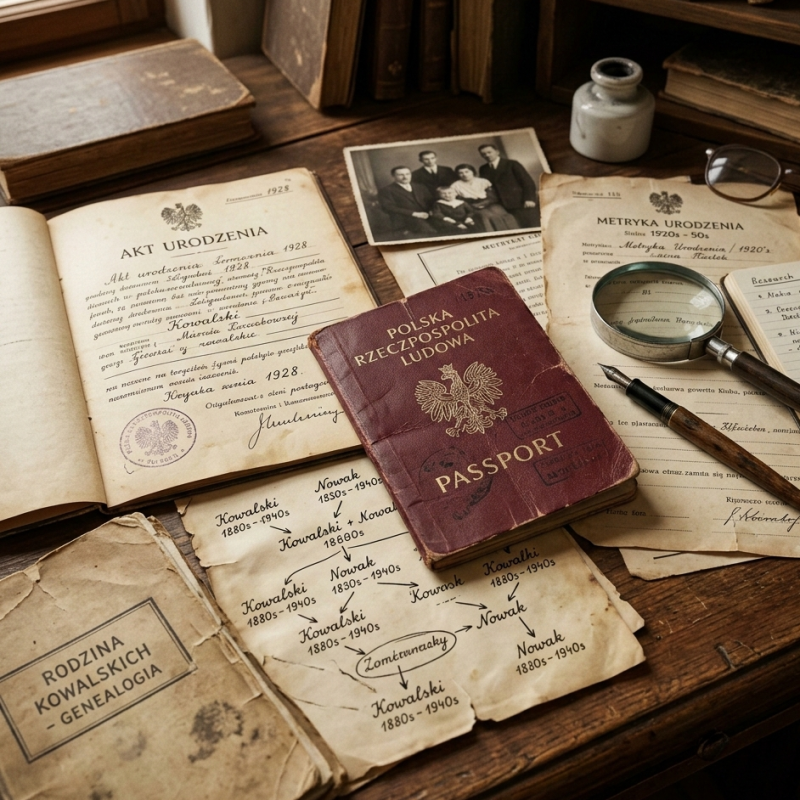
Many people with Polish ancestry discover that they may already be citizens of Poland by law. If a parent or grandparent or sometimes even earlier Polish ancestor held Polish citizenship, it may be possible to confirm your own citizenship through the process known as confirmation of possession or loss of Polish citizenship.
Unlike naturalization, this process does not grant citizenship. Instead, it confirms that citizenship has existed since birth under Polish law. For many applicants, confirming citizenship is the first step toward obtaining Polish passports and enjoying the rights available to citizens of Poland, including the possibility of dual citizenship.
In this guide, we explain how to apply for Polish citizenship by descent and what documents are required.
Understanding Polish Citizenship by Descent
Polish citizenship law is based on the principle of ius sanguinis, or the “law of blood.” This means that citizenship is inherited from a parent or grandparent rather than determined by place of birth.
Because citizenship is inherited, the crucial factor is continuity of citizenship through generations. Each generation must have held Polish citizenship when the next generation was born. If citizenship was lost at any point before a child’s birth, the chain may be broken.
This is why confirming Polish citizenship by descent often requires careful examination of historical documents and legal records.
Who Is Eligible to Confirm Polish Citizenship
Individuals may qualify for citizenship confirmation if they can demonstrate that they descend from a Polish citizen and that the citizenship line remained intact.
Typical qualifying situations include:
- Being born to at least one Polish citizen parent
- Having a Polish parent or grandparent or great-grandparent whose citizenship passed through the family
- Being adopted by citizens of Poland before the age of 16
People whose families emigrated from territories of historical Poland, including those researching Jewish ancestry, may also be able to confirm citizenship if documents prove their ancestor held Polish nationality.
Required Documents for Polish Citizenship by Descent
One of the most common questions people ask is: what documents are required for Polish citizenship by descent?
Because the process is based on proving lineage and citizenship continuity, documentation is critical. The documents required generally include records confirming identity, ancestry, and the citizenship status of the Polish ancestor.
1. Application Form
The official application for confirmation of possession or loss of Polish citizenship must be completed entirely in Polish.
Applications submitted in other languages will not be accepted. This application is submitted to the appropriate authority responsible for Interior and Administration matters through a Polish consulate when the applicant does not reside in Poland.
2. Birth Certificates
Applicants must provide their full birth certificate.
If the applicant was born outside Poland, the certificate must contain:
- Full name
- Date and place of birth
- Names of both parents
Birth certificates for each generation connecting the applicant to the Polish ancestor must also be provided.
3. Proof of Ancestry
Authorities must verify the family connection between the applicant and the Polish ancestor.
Common genealogical records include:
- Civil registry records
- Baptism certificates
- Marriage certificates
- Parish records
- Historical family registers
These records establish the generational chain linking the applicant to the ancestor and help confirm the family’s Polish nationality.
4. Proof of Polish Citizenship of the Ancestor
One of the most important pieces of evidence is proof that the ancestor held Polish citizenship.
Examples of acceptable documents include:
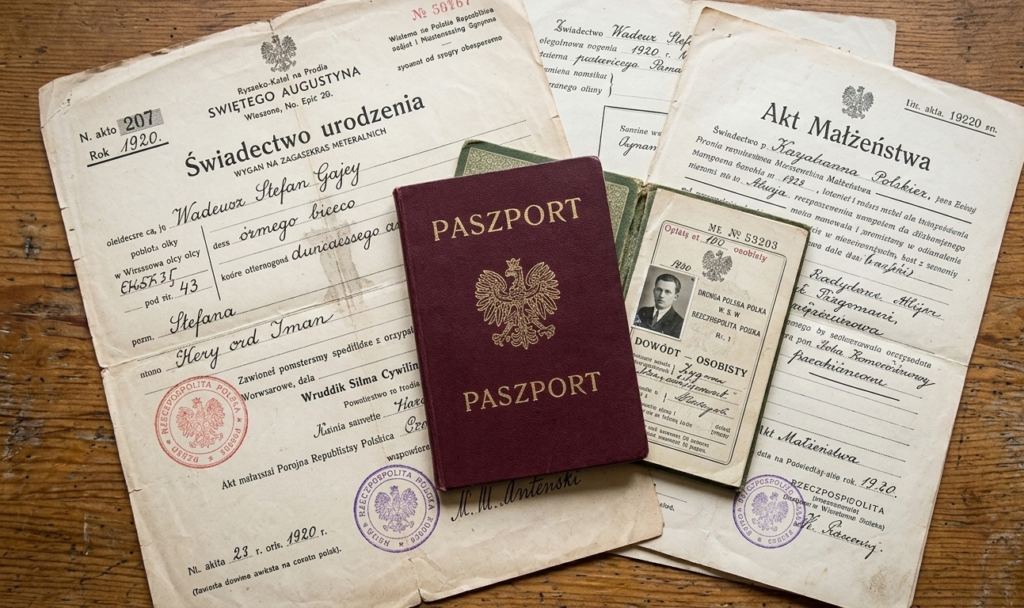
- Historical Polish passports
- Polish ID cards
- Military service records
- Census documents indicating Polish nationality
- Official registry records
In many cases, these documents must be located in Polish, Ukrainian or Belarusian state archives.
5. Marital Status Documents
Authorities must verify changes in family names and legal status across generations.
This may require:
- Marriage certificates
- Divorce decrees
- Death certificates of spouses
These documents help establish continuity in the genealogical chain and ensure that the correct lineage is documented when someone applies for citizenship confirmation.
6. Identity Document
Applicants must also present a valid foreign passport or national ID for identity verification.
The passport is generally used for inspection only and is not retained as part of the file.
Translation and Legalisation Requirements
All documents submitted to Polish authorities must meet specific legal requirements.
Certified Translation
Any document issued outside Poland must be translated into Polish by:
- A sworn translator, or
- A Polish consul
Translations performed by non-certified translators are typically rejected.
Apostille or Legalisation
Documents issued outside the European Union must usually be authenticated with an Apostille under the Hague Convention.
In some cases, legalization by a Polish consulate may also be required.

When Historical Records Are Missing
One of the biggest challenges in confirming citizenship is locating the necessary historical documents.
In cases where original certificates cannot be found, secondary official records referencing Polish nationality may sometimes be accepted.
If you are unsure how to locate historical records needed to obtain Polish citizenship or acquire Polish citizenship through ancestry, professional genealogy researchers can assist with archival searches and document retrieval.
Drevo Research specializes in Eastern European archival research and frequently assists families in locating the documentation required to confirm Polish citizenship by descent.