
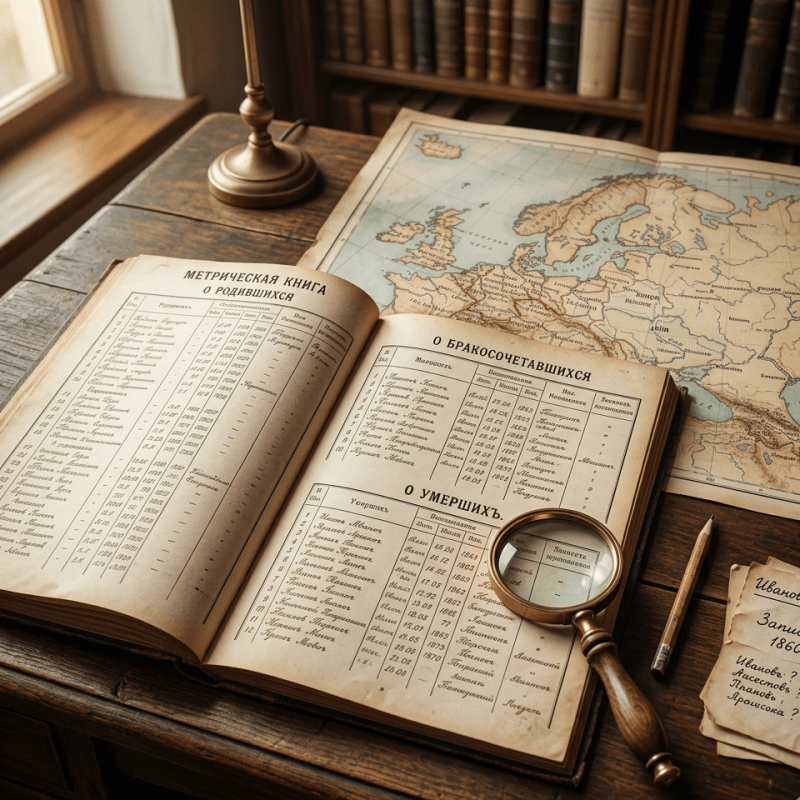
In most cases, vital records from the Russian Empire include birth records, marriage records, and death records. In some communities and periods, divorce records also appear, although much less often. These records were usually kept by religious institutions rather than by a modern civil registry system, which means that where and how they were recorded depended heavily on the family’s confession, the locality, and the period in which the event took place.
The Russian Empire is not the same thing as the modern Russian Federation. A person described as coming from “Russia” in an immigration file, passenger manifest, naturalization paper, or census may in fact have come from a place that is now in Poland, Lithuania, Latvia, Estonia, Ukraine, Belarus, Moldova, or another present-day country. Because of that, the search for Russian Empire records almost always begins with place, not with the imperial label “Russia.”
Russian Ancestry Vital Records
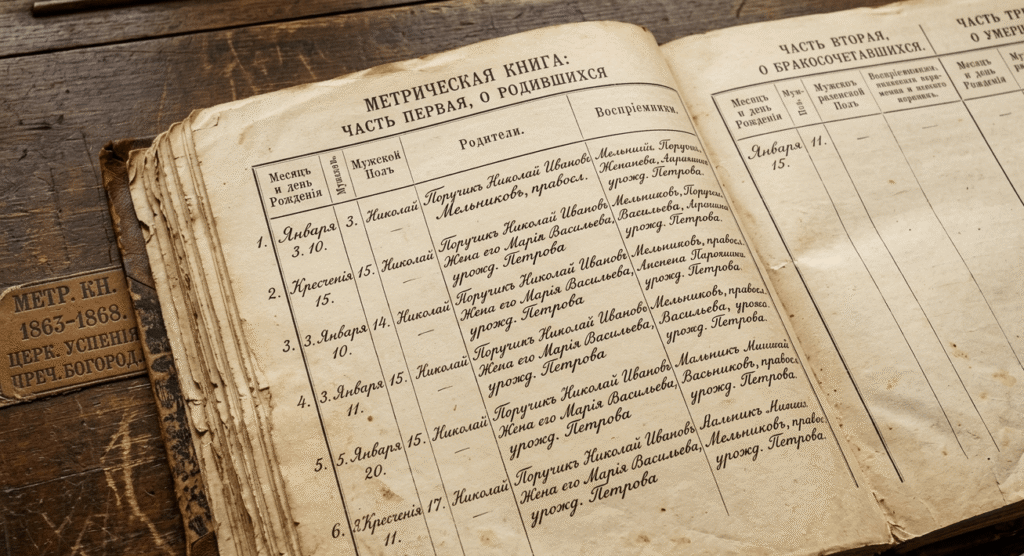
For genealogy research in the Russian Empire, the core vital records are the records of birth, marriage, and death. These were usually recorded in metrical books or metric books kept by the relevant religious authority. In practice, these books served as the official record of life events for much of the empire.
Depending on the family and region, these records may have been kept by:
- Roman Catholic parish
- Greek Catholic parish
- Lutheran congregation
- synagogue or rabbinical authority
- Muslim religious authority
The content of vital records can vary a lot. Russian birth records, Russian marriage records and Russian death records in one region may be quite brief, while a record from another area may include the parents’ names, residence, social status, occupation, witnesses, and other useful details. The structure of the entry often depends on geography, confession, and year when record was registered.
A Practical Step-by-Step Workflow
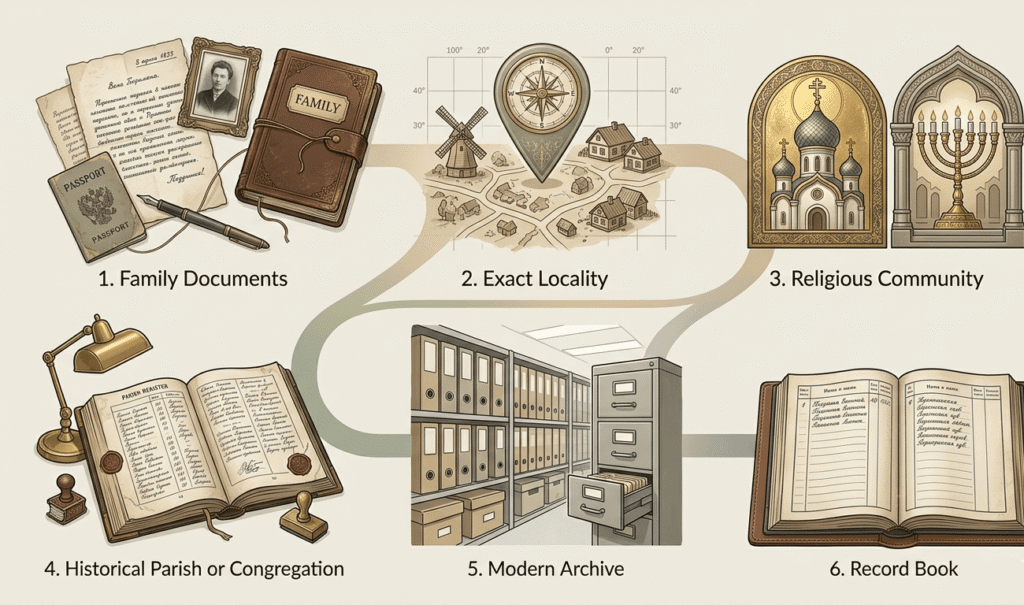
Here is the most effective general workflow for finding Russian Empire vital records.
1. Identify the exact locality
You need the specific town, village, shtetl, or city, not just the province or the word “Russia.” For instance, if your ancestor immigrated to United States then naturalization and arrival records would be extremely helpful to find out where they came from and what original name they came under.
2. Confirm the family’s confession
This helps determine which religious records you need to search.
3. Identify the historical jurisdiction
Figure out the old guberniya, uyezd, volost, parish, or related jurisdiction if possible. This is often necessary for moving from a place name to an archive collection.
4. Determine the modern archive jurisdiction
Find out which modern country and which archive now serves that locality.
5. Identify the likely parish or congregation
This is especially important for villages that did not have their own church or synagogue.
6. Check online resources first
Look for digitized images, indexes, catalogs, and databases before assuming the records require an archive visit.
7. Search broader if needed
If the record is not found, expand to neighboring years, neighboring parishes, and related family members.
8. Use substitute records
If the metric books are missing, look for revision lists, confession lists, military records, census-type sources, and other substitutes.
Why Russian Empire Records Are Often Not in Russia
When older records say that an ancestor came from “Russia,” that often means the Russian Empire, not the modern Russian Federation. A person born in Warsaw, Vilnius, Kyiv, Riga, or Kishinev during the imperial period could easily be described abroad as Russian, even though the records relating to that person are now likely to be held in Polish, Lithuanian, Ukrainian, Latvian, or Moldovan archives.
So if your ancestor was born in Warsaw during the Russian Empire, you would normally look in Polish archives, not Russian ones. If they were born in Kyiv, the search usually belongs in Ukrainian archives. If the place was in Grodno Governorate, the records may now be in Belarus, Lithuania, or another relevant repository depending on the exact locality and archival history.
Why the Exact Locality Matters So Much
If you only know that your family came from “Russia,” “Poland,” “Lithuania,” or “Ukraine,” you usually do not yet know enough to find the record.
Russian Empire vital records were typically created at the level of the parish, congregation, synagogue, or other local religious authority. That means the key question is not “Which country were they from?” but rather:
Which town, village, shtetl, or city neighborhood were they from?
A small village may not have had its own church at all. Instead, its residents may have belonged to a parish in a nearby larger settlement.
This is why identifying the exact locality is usually the single most important first step in finding Russian Empire vital records.
Why Religious Community Matters
The second major step is identifying the family’s religious community.
In the Russian Empire, vital events were usually recorded by confession, not by a universal civil registration system. In simple terms, this means that the family’s religion often determines which record set exists and where it was kept.
For example, a family from the same town might appear in completely different records depending on whether they were:
- Roman Catholic
- Greek Catholic
- Lutheran
- Jewish
- Muslim
For many families, identifying the confession is not difficult because it is already known through family memory, cemetery evidence, naming patterns, or other records. But researchers should stay open-minded. Mixed-confession families, conversion, changing jurisdictions, and later retellings can all create confusion.
What Information You Should Know Before You Start Searching
Before you begin looking for a specific birth, marriage, or death record, it helps to gather as much of the following as possible:
- surname spelling variants
- given-name variants
- approximate year of birth, marriage, or death
- exact town, village, shtetl, or city
- parents’ names
- religion or confession
You do not need all of this to begin, but the more of it you know, the more accurate the search will be.
Name variation is especially important, given names and surnames could change over the time. Immigrants from the Russian Empire often changed their names. Place names also changed over time, so it is important to keep it in mind.
Online Records Have Limits
A common mistake is assuming that if a record is not online, it does not survive.
In reality:
- many records are not digitized
- many digitized records are not indexed
- many indexed records do not include images
- some archive websites show only the catalog, not the documents
- some materials can only be accessed through a formal request or in-person research
What to Do If the Record Is Not Found
Not finding the record on the first pass does not mean it is gone.
Here are some of the most common next steps:
Search neighboring years.
Family memory and later records are often off by a few years.
Search neighboring parishes.
The family may have belonged to a different parish than expected.
Search siblings.
A sibling’s birth, marriage, or death record may reveal the parents’ names, residence, or parish.
Many breakthroughs happen only after the researcher stops treating the target person as an isolated case and starts reconstructing the wider family network.
Alternative Records When Vital Records Are Missing
If the exact birth, marriage, or death record does not survive, other sources may still help prove the family.
Some of the most useful substitute records include:
Revision lists
These are census-like tax records that list household members and can help establish family structure.
Confession lists
These can show annual household composition within a parish.
Military records
Conscription and service records may include ages, birthplaces, and relatives.
The 1897 census and related materials
Where available, these can provide household and identity details.
Estate or class records
Nobility files, merchant records, peasant registers, and similar sources may preserve family information.
A missing metric book is a problem, but it is not always the end of the trail.

When Professional Help Makes Sense
Some searches are straightforward. Others are not.
Professional help is often useful when:
- the locality is unclear
- the parish is difficult to identify
- the records are in a hard-to-access archive
- the material is not digitized
- a certified archival copy is needed
Once the exact locality is identified, an experienced researcher can often determine the most likely archive path much faster, request scans, and locate the right collection with fewer false starts.
Final Thoughts
Finding birth, marriage, and death records from the Russian Empire is not really about searching “Russia.” It is about identifying the exact place, the religious community, and the archive that now holds the records.
Once you understand that logic, the whole process becomes clearer.
The most important rule is simple: start with the locality, not the imperial label. From there, work outward through confession, parish, archive jurisdiction, and record type. That is the foundation of almost every successful Russian Empire vital-record search.